
Reports

Lessons in War 2015: Military Use of Schools and Universities during Armed Conflict

Submitted by Marilu on

This study examines the use of schools and universities for military purposes by government armed forces and opposition or pro-government armed groups during times of armed conflict or insecurity. Schools are used for barracks, logistics bases, operational headquarters, weapons and ammunition caches, detention and interrogation centres, firing and observation positions, and recruitment grounds.
The study highlights examples of good practice, in which governments have adopted policies that explicitly ban or restrict militaries from using education facilities.

Thematic report on the State compliance towards the realisation of the right to early childhood care and education in Uganda

Submitted by Delphine Dorsi on

Alternative report submitted to the UN Committee on the Rights of the Child for the 3rd, 4th and 5th Combined Periodic Review of  the Republic of Uganda, at its 100 Pre-Sessional Working Group.

Tags

The right to be safe - Report of the Special Rapporteur on the Right to Education, Farida Shaheed

Submitted by Marianne on

The Special Rapporteur proposes to define the right to be safe in education as the right of learners, educators and non-teaching staff to be protected from any violation of their physical, sexual or psychoemotional integrity, as well as from practices that might harm or endanger healthy relationshis within and outside the educational environment and the free expression of identities, in all educational spaces and processes, including digital ones.

Tags

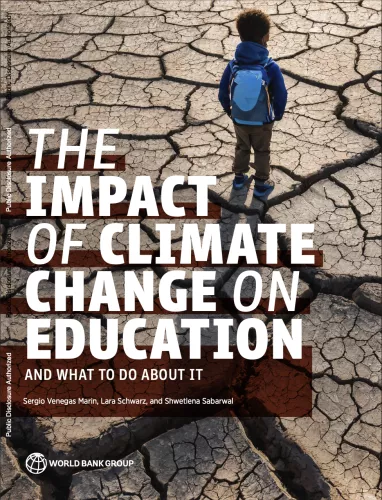
The impact of climate change on education and what to do about it

Submitted by Marianne on

This paper lays out four concrete ways in which governments can protect education systems from climate change so that their positive impacts on economic development, poverty alleviation, and social cohesion can be sustained and boosted. These are: (i) education management for resilience; (ii) school infrastructure for resilience; (iii) ensuring learning continuity in the face of climate shocks; and (iv) leveraging students and teachers as change agents. The paper presents an actionable agenda for each of these with operational examples in different contexts.

Learning at risk: the impact of climate displacement on the right to education; global report

Submitted by Delphine Dorsi on

This report aims to examine the barriers to education as a result of climate change and climate displacement, taking into account the policy implications of heightened human mobility. The comparative analysis contained is based on research undertaken in four regions around the globe (Central America and the Caribbean, Asia-Pacific, South-Eastern Europe and East Africa). The key conclusion of the analysis is that climate change poses direct and indirect threats to the fulfillment of SDG 4 and the right to education in all four regions studied.

Report to the CESCR for the 7th review of the UK - The UK international development cooperation in the area of education: updates and recommendations

Submitted by Delphine Dorsi on

This report was submitted to the UN Committee on Economic, Social and Cultural Rights for the 7th review of the UK. It is an update of a first report submitted in 2023. It covers:

Tags

Right to Education: confronting inequalities by addressing privatisation, digitalisation and crisis situations

Submitted by Delphine Dorsi on

Geneva Dialogue on the Right to Education was held on 18 and 19 June 2024 and organized by the Swiss Commission for UNESCO, UNESCO, the University of Geneva, the Office of the United Nations High Commissioner for Human Rights (OHCHR), and the REGARD network.

Report of the UN Special Rapporteur on the right to education on Artificial intelligence in education

Submitted by Margherita on

In October 2024, the Special Rapporteur on the right to education, presented her report on AI in education, emphasiaing a human rights-based approach to its regulation. She showed AI's potential to advance access to education, particularly for individuals with disabilities and remote communities, while cautioning against its risks, such as undermining human connection, increasing digital divides, and excluding minority groups.